What is Rosh Hashanah?

Rosh Hashanah, literally “head of the year,” marks the beginning of the Jewish New Year. It also marks the beginning of the ten Days of Awe leading up to Yom Kippur, the Day of Atonement. The Days of Awe are a period of introspection and repentance in preparation for Yom Kippur.

On the Jewish calendar, Rosh Hashanah falls on the first two days of the month of Tishrei. The Bible does not refer to the holiday as Rosh Hashanah; rather, it describes the holiday as Yom Hazikaron, the Day of Remembrance, and Yom Teruah, the Day of the Blowing of the Shofar, or the Feast of Trumpets (Leviticus 23:23-25; Numbers 29:1-6). During synagogue services, the Jewish community sounds the shofar (ram’s horn) as a call to repentance.

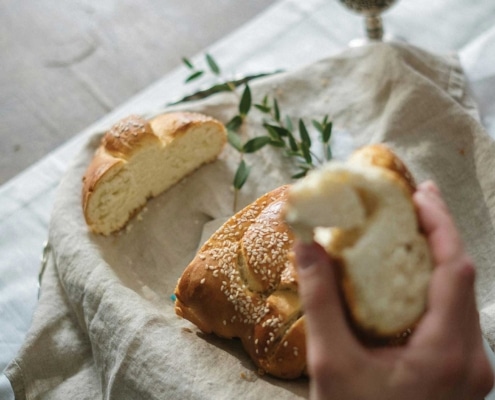
Special foods are eaten during Rosh Hashanah. For example, we dip apples in honey to symbolize a good and sweet new year. Traditionally, we eat pomegranates as part of the holiday celebration, because we hope our good deeds in the coming year will be as numerous as the seeds of a pomegranate.
Tashlich

Tashlich, Hebrew for “you will cast,” is one of the most significant observances of Rosh Hashanah. During Tashlich, Jewish communities gather along bodies of running water to say prayers and toss bits of bread into the flowing water, symbolizing the casting of one’s sins into the depths of the sea. The prophet Micah states, “He will again have compassion on us; He will tread our iniquities under foot. Yes, You will cast all their sins into the depths of the sea” (Micah 7:19).

Paul speaks of the resurrection of the dead at the sound of the blowing of the shofar (1 Corinthians 15:50-54; 1 Thessalonians 4:13-18). During this time, God will transform the bodies of believers who have died, giving us new, immortal bodies. The sounding of the shofar encourages us to remember that our present bodies are only temporary and to look forward to our eternal bodies, in which we will live in an unbroken relationship with God.

Invite a Speaker

Would you like a High Holiday service at your church? Invite one of our missionaries!

ARTICLES

Joshua Aaron Concert

Roast Chicken Recipe

Recipes

Roast Chicken Recipe

Brisket Recipe

Rosh Hashanah Resources

Chosen People Ministries offers you some wonderful resources to help you better understand the Rosh Hashanah and the other High Holidays.

High Holiday Booklet


Explore the High Holidays with our yearly High Holiday booklet!

Israel’s Holy Days

A Jewish believer in Jesus examines the festivals of Leviticus 23, their history, their present celebration in the synagogue and home, and their prophetic fulfillment. In Leviticus 23 God presents seven annual sacred feasts of Israel. At first this passage seems to simply list Israel's holy days, but the more one studies the Bible, both the Old and New Testaments, the more one realizes that this passage is more than just a list of holy days; it is actually an outline of God's calendar from eternity to eternity. Israel's Holy Days in Type and Prophecy is a brief but thorough review. By Daniel Fuchs.

Fall Feasts of Israel

Israel's three most significant biblical festivals – Rosh Hashanah, Yom Kippur and Sukkot – are examined in full, including a look at their biblical roots, their celebration in the time of Messiah, and by Jewish people today. The Fall Feasts of Israel is an invaluable guide to help you understand these wonderful biblical festivals as well as their significance for your spiritual life as a believer in Messiah, whether Jew or Gentile.